


Namor in Black Panther: Wakanda Forever and Ancient Maya Rulers


When Black Panther: Wakanda Forever (2022) hit theaters, the appearance of Namor as the ruler of Tlaokan came as a surprise. Instead of borrowing from his comic book Atlantean roots, Marvel opted to draw on the world of the ancient Maya—OK, not just the Maya, there is a lot of general Mesoamerican-ness happening. It's not a perfect historical fit. Marvel took a lot of creative liberties, but I still think it is fascinating to see how elements of Classic Maya art and rulership appear in the movie and Namor's look. And to consider WHY they used them.

Maya Rulers in Classic Period Art
During the Classic period (c. 200–900 CE), Maya kings and queens commissioned carved stelae, painted vases, and elaborate burials to display their power and authority. These artworks presented rulers as divine and as divine intermediaries, dressed in regalia that connected them to the gods. Jewelry, headdresses, and jade ornaments weren’t just fashion but symbols of cosmic power, wealth, lineage, and legitimacy.

One of the best examples comes from the tomb of Pakal, the famed ruler of Palenque in present-day Chiapas, Mexico. When archaeologists uncovered his tomb in 1952, they found his body adorned in a jade mosaic death mask, jade ear spools, and an array of collars, nose ornaments, and pendants. His sarcophagus lid shows him poised between worlds, connected to a great cosmic tree, which visualizes his rebirth as the Maize God.

Namor's regalia
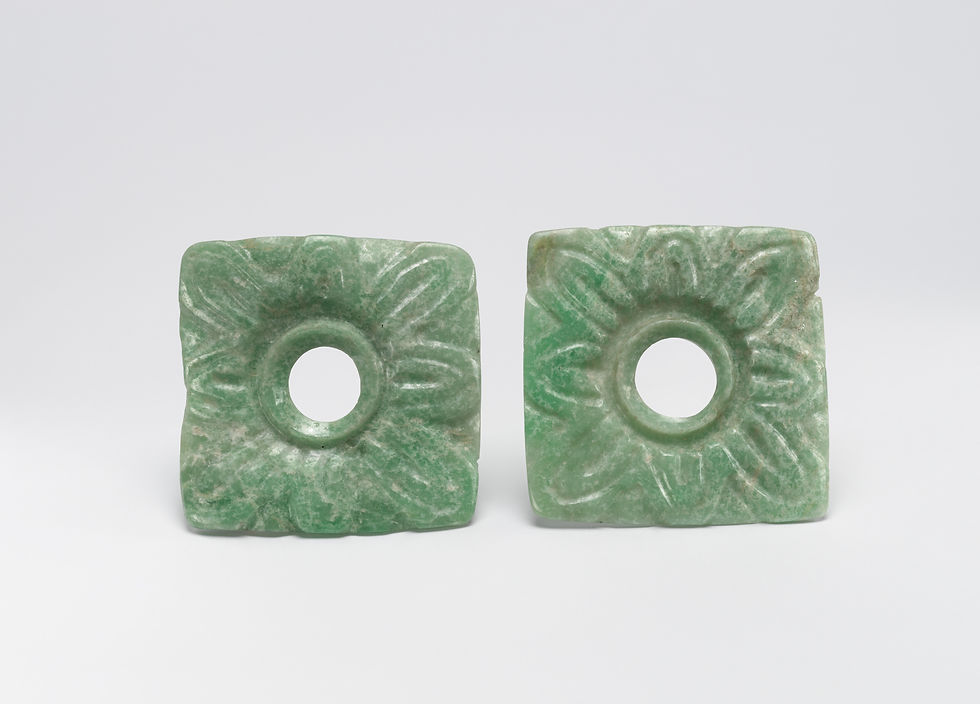
If you look closely at Namor’s costume, you’ll notice how it borrows from Classic Maya royal imagery and regalia, like Pakal. Namor wears a collar and pectoral, or wide chest ornaments, like those seen on Classic stelae. However, Marvel’s version looks more ancient Egyptian in style than Maya. Namor also dons large ear spools, or large discs inserted into stretched earlobes, instantly recognizable from Pakal’s jade ornaments.

The ruler of Talokan also wears a distinctive nose bar, another marker of Classic Maya elite identity, often crafted in jade or shell. These details aren’t accidental. They tap into a long tradition of how ancient Maya rulers presented themselves, both in life and in death.
The Power of Jade
Namor’s green jewelry is actually one of the most historically rooted aspects of his costume and adornments. For the ancient Maya, jade was more precious than gold. Its green hues linked it to maize, the sacred crop at the center of Maya society, and to vegetation and fertility more broadly.
That’s why Pakal’s tomb was filled with jade. His death mask, ear spools, and chest ornaments weren't just luxury items. They helped to transform him into the Maize God, ensuring renewal and abundance for his people. By wearing jade, Maya rulers embodied life-giving power. Namor’s jade jewelry visually ties him to the same associations of fertility, rebirth, and rulership. They are also clearly intended to suggest Namor's "Maya-ness."

Creative Liberties
Marvel didn’t replicate Maya art outright. As I noted earlier, some of Namor’s regalia seems like a cultural mashup, blending Egyptian, Mesoamerican, and even pan-Indigenous aesthetics. His feathered ankle wings (straight from the comics) have no Maya precedent.

At the same time, specific details draw on real objects: the broad chest collars and jade ornaments evoke regalia from Calakmul, one of the great superpowers of the Classic Maya world during the 6th–8th centuries. Kings at Calakmul, Palenque, and Tikal often appear on stelae draped in heavy jade collars and nose bars, their jewelry signaling not just wealth but divine authority. Namor’s costume may not be an exact copy. Still, it borrows the visual language of Maya kingship to highlight his role as a powerful, god-like ruler in Black Panther: Wakanda Forever.
Black Panther: Wakanda Forever and Ancient Maya Rulers, Why Do These Connections Matter?
Big-budget films often borrow from world history, not always in a responsible manner. What makes Namor compelling, in my opinion, is that the adaptations are very intentional—why not just use what was in the comic? Why look to Mesoamerica? Why pair Black Panther: Wakanda Forever and ancient Maya rulers? It's mainly because of the messages about conquest and colonialism that are important to the movie overall. I'll tackle that one in a separate post.
Namor might be fictional, but his look reminds us of the very real Maya kings who ruled city-states like Palenque and Calakmul, and whose legacy (clearly) still inspires us today.
CITE THIS PAGE: Kilroy-Ewbank, Dr. Lauren. "Namor in Black Panther: Wakanda Forever and Ancient Maya Rulers." September 24, 2025. lkilroyewbank.com <Insert date you accessed> https://www.lkilroyewbank.com/post/namor-in-black-panther-wakanda-forever-and-ancient-maya-rulers
Learn more
Want to learn more about the discovery of Pakal's tomb? Read my essay over at ARTSQ: https://www.artsq.org/blog/pakal-tomb-sarcophagus-archaeological-discovery
Learn more about ancient Maya art and culture—and other Mesoamerican civilizations—with ARTSQ's Early Mesoamerica and Later Mesoamerica materials.


Comments